
Information
Custom Software Development And its Need
Choosing between custom software and off-the-shelf tools can be a difficult decision for growing businesses in Nepal. While ready-made software is quick to set up and often affordable, it may not fit the way your business actually works. Custom software takes a different approach by building features, workflows, integrations, and user experiences around your specific needs. This guide explains the key differences, when custom development makes sense, and when an existing tool may be the better choice for your business.
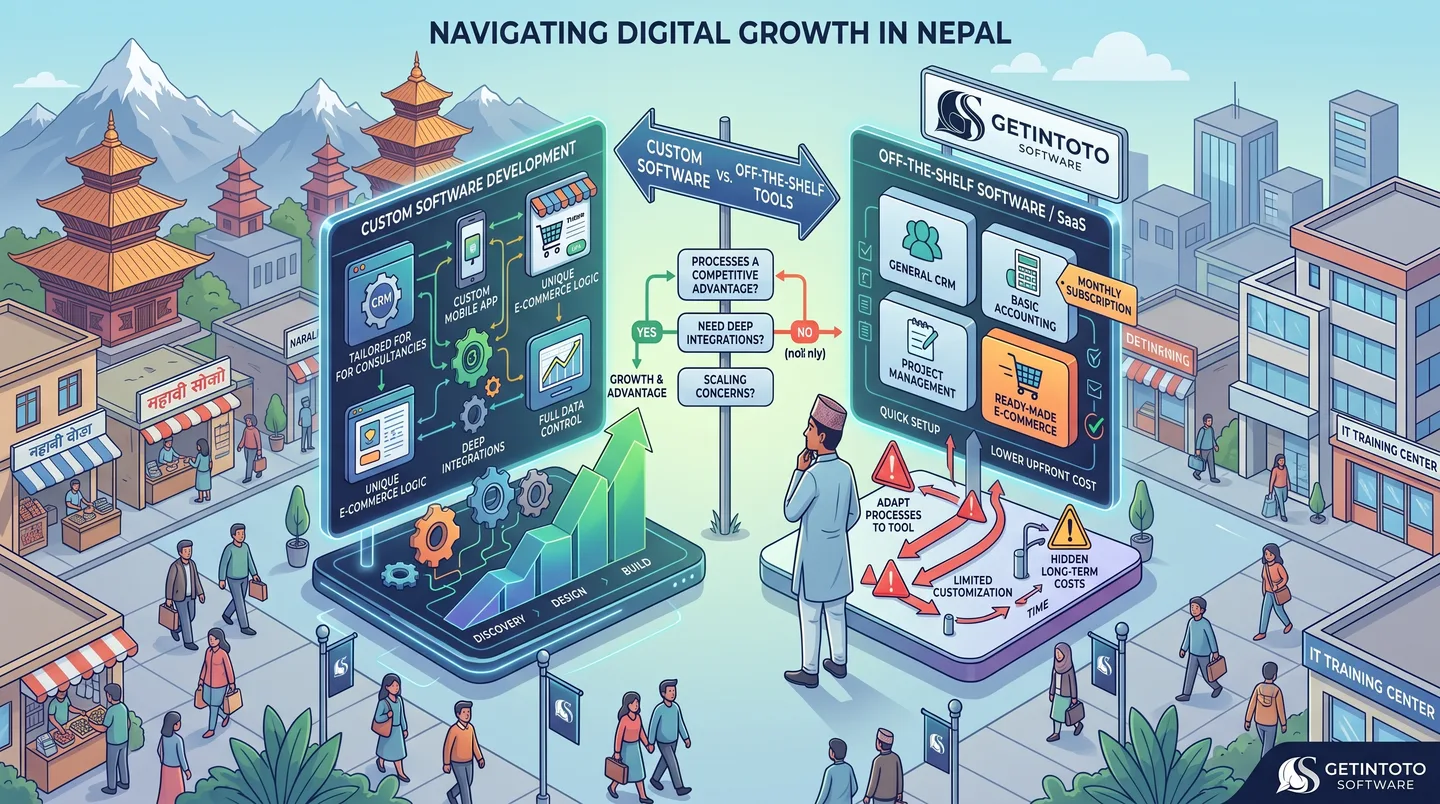
What Is Custom Software Development and When Does a Business in Nepal Need It (vs. Off-the-Shelf Tools)?
As every Nepali growing business faces the question, should we continue to use pre-built tools, or should we start creating something that will work for our business?
Off-the-shelf software (such as SaaS tools, packaged products, or ready-made platforms) are available to get started quickly but are limited to available features. Custom software development is a solution that creates a system based on one's specific processes, data and objectives. Both are not necessarily superior. Deciding is dependent upon your business goals, the uniqueness of your workflows and the length of time you intend to use the system.
We develop specialized tools, websites, mobile apps and platforms for businesses in Nepal and beyond at Getintoto. This has been a dilemma for education consultancies, trading companies, healthcare suppliers and service companies alike. The guide helps you make an informed decision.
What Is Custom Software Development?
Custom Software Development involves creating software for a single company. It is not a common product used by thousands of companies. On the contrary, the features, workflows, reports, integrations and user experience are designed in accordance to the way your team works.
Typical examples include:
- A CRM specific to study-abroad consultancies that keeps all leads, applications, university matching and payments organized in a single system (like the specialized systems we build).
- A mobile application that allows field staff, or customers, to use services in the same way that your business currently does.
- Internal platform which links inventory, sales and accounting in one place rather than forcing employees to switch between five tools.
- An e-commerce platform that cannot be easily implemented by an e-commerce system without the help of product rules, pricing logic, or fulfillment steps.
Typically, it has well defined phases: Discovery – understanding the actual problem, Architecture/Planning – defining the architecture and planning, Design – design, Iterative Building – built in an incremental fashion, with a regular demo, Test – testing, Launch – launch and Maintenance – maintenance after launch. The aim is not to just provide some code, but to provide a system to minimize friction and facilitate growth.
What Are Off-the-Shelf Softwares ?
Off-the-shelf softwares are those software that are ready-made. You either subscribe, or purchase a license and configure a few settings, and start using it. Some of the most common types of software are general CRMs, accounting systems, project management software, basic ecommerce solutions, and HR software.
These tools really excel when the problem is shared. Mature products do a good job of accounting, email, basic inventory tracking, or simple customer lists. Updates, security patches and support from the vendor. The set up time can be months instead of days and weeks. The downside to this is that you change your processes around to fit the software.
Custom Software and Off-the-shelf Software Key Differences
Aspect | Custom Software | Off-the-Shelf Software / SaaS |
Fit to your processes | Built around your workflows | You adapt to the tool |
Upfront cost | Higher (investment in design & build) | Lower (subscription or license) |
Time to first use | Months (depending on scope) | Days to weeks |
Long-term cost | Predictable maintenance | Subscriptions that grow with users + add-ons |
Customization | Unlimited | Limited to what the vendor allows |
Integrations | Designed for your existing systems | Depends on available APIs and connectors |
Ownership & control | You own the code and data | Vendor controls roadmap and infrastructure |
Competitive advantage | Can encode unique processes | Same tool competitors can use |
Custom solutions are consistently proven to be the most cost-effective option for industry over three to five years when user numbers increase and when workarounds become costly. The point at which it crosses over to the other will be different depending on scale and complexity.
When a Business in Nepal Needs Custom Software
Custom development makes sense in these common situations we see with Nepali companies:
1. Your processes are a real competitive advantage
Industry analyses indicate that the total cost of ownership is generally more cost effective for custom solutions after three to five years because of increased user numbers, or increased cost of workarounds. The exact crossover will vary with scale and complexity.
2. Workarounds have become a second job
Staff have to waste hours copying data from one system to another, running parallel spreadsheets or explaining to software how to handle exceptions. The hidden cost is high if new members have to learn the workarounds, not the work, in weeks.
3. You need deep integration with existing systems
A lot of businesses are already using accounting software, inventory or payment systems in Nepal. It is possible to build a custom program to communicate properly with those systems from the outset. Middleware or manual transfers are usually needed with off-the-shelf tools.
4. Data control, compliance, or unique reporting matters
You require particular audit trails, data residency or reports that are not provided by any standard product. Or you just want to have the source code and roadmap all yours.
5. You have outgrown the limits of current tools
Growth is now being limited by user seats, volume of transactions, or user features. When you're spending ten dollars per person, it's fine, but when you're spending fifty or a hundred dollars per person it becomes painful.
6. Software becomes a part of your product or customer experience
If a client-facing portal, mobile app or platform is used on a regular basis by customers then it is better to be tailored than generic.
Examples in the local landscape are study abroad companies that require a specific matching of universities and document workflows that aren't easily replicated with global CRM, healthcare product suppliers who must have access to specific inventory and ordering rules and multi-location service companies who need to enable seamless mobile access for staff, customers, and business partners.
When is using an off-the-shelf tool the better solution?
Continue using or begin using pre-made tools when:
- Not a differentiator – basic accounting, email, simple project tracking, basic HR, etc.
- You need something that will work in days or a few weeks, not months.
- When the problem is not too complicated, and you have only so much money for the first year.
- If you are at the stage where a well matured product already suits 80-90% of your requirements with reasonable configuration, then you are on the right track.
- When still testing the business model, you want to remain flexible.
Many successful businesses choose a mix of both: off the shelf for the business processes that can be executed in this way, and custom software for the processes that make the business unique thanks to modern APIs.
A Practical Decision Framework for Nepali Businesses
Be honest and ask yourself these questions:
- Does this process add value to the company's products or services and help customers gain greater value than our competitors?
- What time and money are we already devoting to workarounds, additional tools and training for limitation?
- Is there likely to be a significant increase in our user numbers or transactions within the next 2–3 years?
- Are there integrations that present tools don't do so well?
- What are the relative values of features, data and costs in the long-term?
If three or more answers go towards uniqueness, growth friction, or control, custom software should be considered seriously. Instead of seeing only the initial invoice, estimate a rough 3-5 year total cost of ownership.
Cost Reality Check
Each custom project is unique. A focused internal tool or special CRM module is really quite distinct from a complete enterprise platform. The important thing is to have a clear scope. At Getintoto Software, we begin with discovery, working on a problem, not a wish list.
The pre-made option is the more affordable choice up front. Eventually, fees per seat, add-on requirements, integration, and the productivity impact of not a perfect fit make up for this. The most sensible one is the one that's going to minimize overall friction in the years ahead.
The approach taken at Getintoto towards custom software.
We always view custom development as addressing a business need, rather than just coding for the sake of coding. Our normal is:
- To understand goals, users, and the actual constraints.
- Structure and map out before production.
- Agile construction, with frequent demos to see the progress.
- Launch followed by support, because going-live is just the beginning.
We have worked with clients from education, healthcare, trading, real estate and among others. The common denominator is the structure of the building that is designed around the client's real processes, rather than making the client change their working methods.
Final Thoughts
Custom software development isn't a task of reinventing the wheel. It's all about creating the correct vehicle for the road you are actually driving. There are still many tools available that are good for the "business as usual" case, and can be used for quick starts. Custom solutions take power when your processes, scale, or customer experience requires more precision.
In businesses that have grown past the use of simple digital tools, the dilemma is, “Can we afford custom?” rather than “Can we afford the continuous expense of tools that don't fit?”
Whether you are looking at a CRM, internal platform, mobile app, ecommerce solution or any other specialised tool, the first discussion is all about defining the issue.
We are happy to discuss it with you. We believe that every vision should be translated into a coded reality and not one you have to work around, for the right software should work like you do.
The short version
Choosing between custom software and off-the-shelf tools can be a difficult decision for growing businesses in Nepal. While ready-made software is quick to set up and often affordable, it may not fit the way your business actually works. Custom software takes a different approach by building features, workflows, integrations, and user experiences around your specific needs. This guide explains the key differences, when custom development makes sense, and when an existing tool may be the better choice for your business.
Keep reading
AI Tools For Developers
AI is transforming the way developers approach software development by reducing repetitive tasks, simplifying complex workflows, and improving productivity. In this article, we explore practical AI tools that Nepali developers can use to minimize development fatigue, streamline everyday tasks, and focus more on building high-quality, innovative software solutions.
Read article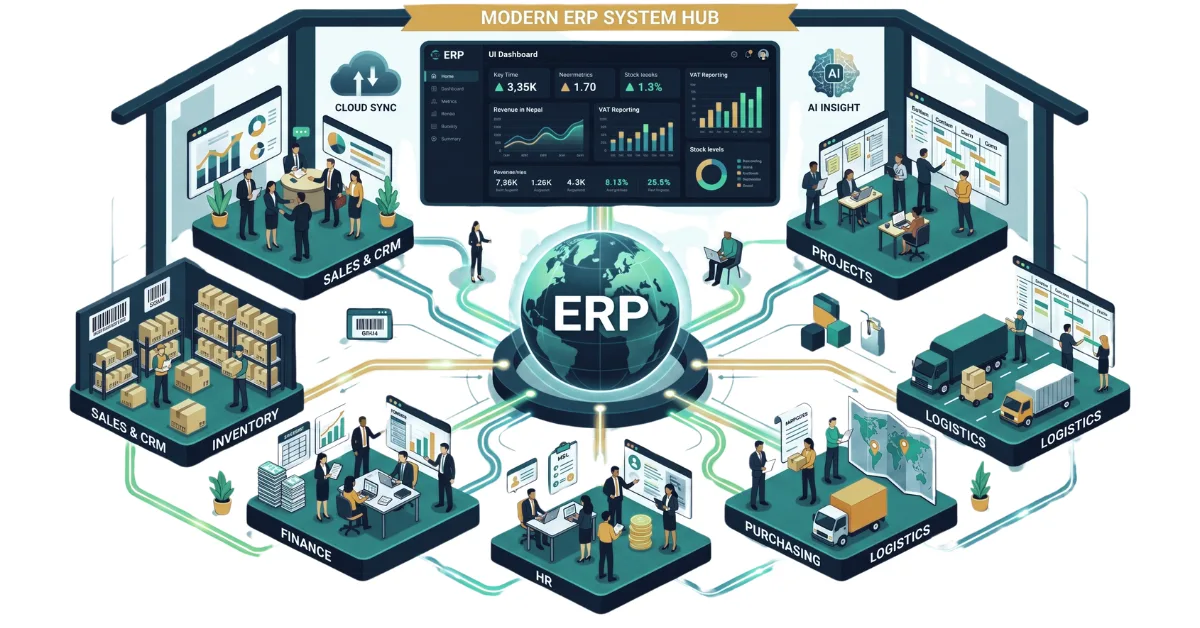
A Complete Guide to ERP and Its Importance in 2026
Discover what ERP is and how it centralizes your sales, inventory, HR, and finance. Explore key modules, workflows, and why modern ERP software is essential in 2026.
Read article
Laptop Specifications Demystified : A Clear Guide for Nepal
Confused by tech jargon? Master the basics of laptop hardware with our clear, beginner-friendly guide to buying the right laptop without overpaying in Nepal.
Read article
Things To Consider Before Buying a NEW LAPTOP in 2026
Stop buying laptops based on the processor name alone. Use our ultimate 2026 checklist to audit RAM, storage, and battery life before swipe-purchasing your next machine.
Read article
What is SEO and Why does every business need it in 2025?
Want your website to rank on the first page of Google? Learn exactly how SEO works and why it is the ultimate survival tool for digital businesses today.
Read article